Japan · Fireworks · Ibaraki
Tsuchiura Fireworks Competition 2026 — the English viewer's guide
One night. About 20,000 shells. Japan's finest pyrotechnicians, competing for the crown. This is everything you need to enjoy the 95th edition like a local: how the competition works, which seats to choose, how tickets work now, how to get there from Tokyo — and how to get home.
| Event | The 95th Tsuchiura National Fireworks Competition (Tsuchiura Zenkoku Hanabi Kyogi Taikai) |
|---|---|
| Date | Saturday, November 7, 2026 |
| Time | 17:30–20:00 JST |
| Venue | Sakuragawa riverbank (Sakuragawa Riverside), near Gakuen Ohashi Bridge, Tsuchiura City, Ibaraki Prefecture |
| If weather turns | Postponed to Saturday, November 14, 2026 in severe weather; cancelled only if both dates prove impossible |
| Scale | About 20,000 shells in a single evening; reserved seating for roughly 45,000 spectators |
| Format | Judged competition in three divisions, plus organiser showcase sequences |
| Nearest station | Tsuchiura Station, JR Joban Line — shuttle buses run on the day |
Why this festival is different
On one Saturday night each autumn, the riverside city of Tsuchiura hosts the most prestigious fireworks competition in Japan. Most fireworks shows are entertainment — Tsuchiura is sport. It is not a display with a contest attached; it is a genuine championship. Pyrotechnics companies from all over Japan enter their very best work and are judged on it, in three divisions:
- Star Mine — rapid-fire sequences launched in quick succession; judged on rhythm, colour and choreography.
- No. 10 shells — the largest single shells in the competition, blooming hundreds of metres across; judged on the perfect roundness and craftsmanship of a single, enormous flower.
- Creative Fireworks — original designs, characters and shapes; judged on imagination.
The crowd's favourite moment is the organiser's showcase Wide Star Mine, the famous "Tsuchiura Hanabi-zukushi", fired simultaneously from several points along the river so the whole sky fills at once. When it comes, put the phone down and just watch.
A century of history
The competition began in 1925, founded by Akimoto Baiho, head priest of Shinryu-ji Temple, to honour members of the Kasumigaura Naval Air Corps who had died in service, and to lift a town struggling in the recession that followed the Great Kanto Earthquake. It grew into one of Japan's three great fireworks competitions, alongside the Omagari competition in Akita. The year 2025 marked the festival's centenary; the 95th edition in 2026 is billed as the first step into its next hundred years.
The November advantage
Unlike Japan's famous summer festivals, Tsuchiura fires in November. It is properly dark by 17:30, the autumn air is crisp and clear, and the colours read cleaner than on a humid summer night. There is no summer heat or mosquitoes, far fewer weather cancellations than typhoon season — and it pairs naturally with an autumn trip, when the late colours around Lake Kasumigaura and Mt. Tsukuba are at their best. The trade-off is the cold: plan for a winter evening, not a summer one.
Seat types compared
Paid seating sits in two zones. The sajiki zone occupies the riverbed directly facing the launch site — shells burst almost overhead. The chair zone lines the riverbed with rows of individual pipe chairs. All paid seats are reserved, and your exact plot or seat number is issued with your ticket.
| Seat | What it is | Best for |
|---|---|---|
| Sajiki Full Plot (Full Masu) | Boarded plot of about 1.7 m × 1.7 m for up to 5 people (four adults sit most comfortably), with a blue ground sheet | Families and groups who want their own space |
| Sajiki Half Plot (Half Masu) | Boarded plot of about 1.7 m × 0.85 m for 2 people, on the same blue sheet | Couples and pairs — the classic two-person choice |
| Sajiki Chair Seat | Individual pipe chair set on the embankment slope inside the sajiki area — a seat, with a slight elevation | Solo visitors who want chair comfort and a raised view |
| Sajiki Table Seat (4 people) | A long table with four pipe chairs on its own plot | Groups of four who plan to eat, drink and watch in comfort |
| Chair Seats A / B / C | Individual pipe chairs in rows on the riverbed; the three grades sit in different zones at different distances | Solo visitors and pairs; the simplest way into the paid area |
Good to know before you choose
- Sajiki plots are board flooring covered with a blue sheet — comfortable with a cushion, and distinctly hard without one. Bring one (see What to bring).
- In some positions, the embankment can clip the lowest fireworks. Mid and high shells — including every No. 10 shell — are visible from all paid seats.
- Chair grades A, B and C are about position, not comfort: all three use the same style of pipe chair.
- Groups should book a single plot type together — plots and chairs are in separate zones and cannot be mixed on the night.
Get the full PDF guide — free on Ko-fi
This page is the essentials. The full 11-page PDF adds the complete on-the-day playbook, and it's free in my Ko-fi Shop — save it to your phone for the riverside, where the network jams on the night.
Download the free Tsuchiura guide (PDF)Venue maps: where you'll sit
The venue is a long, narrow strip of riverbank, and everything faces one way. The launch sites sit on the far bank of the Sakuragawa; every paid seat is on the near bank, angled toward them, with Gakuen Ohashi Bridge at the upstream end. The three diagrams below are the organisers' own — save them to your phone before you go.
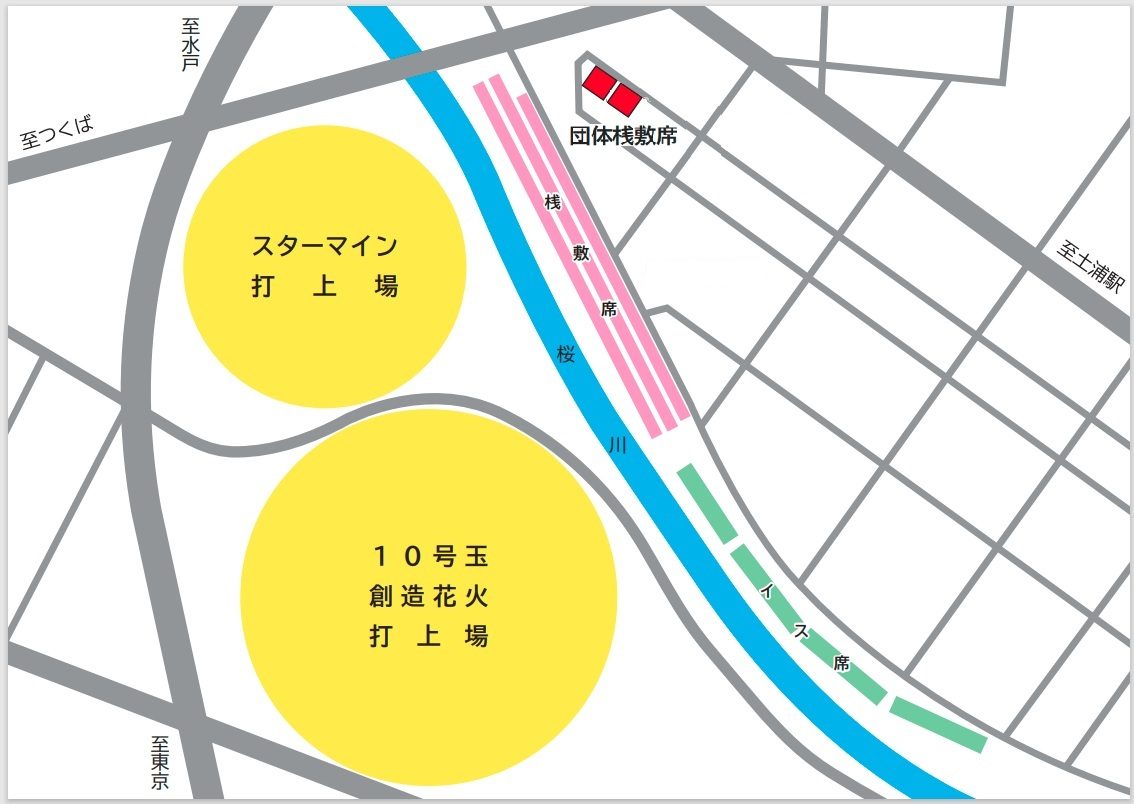
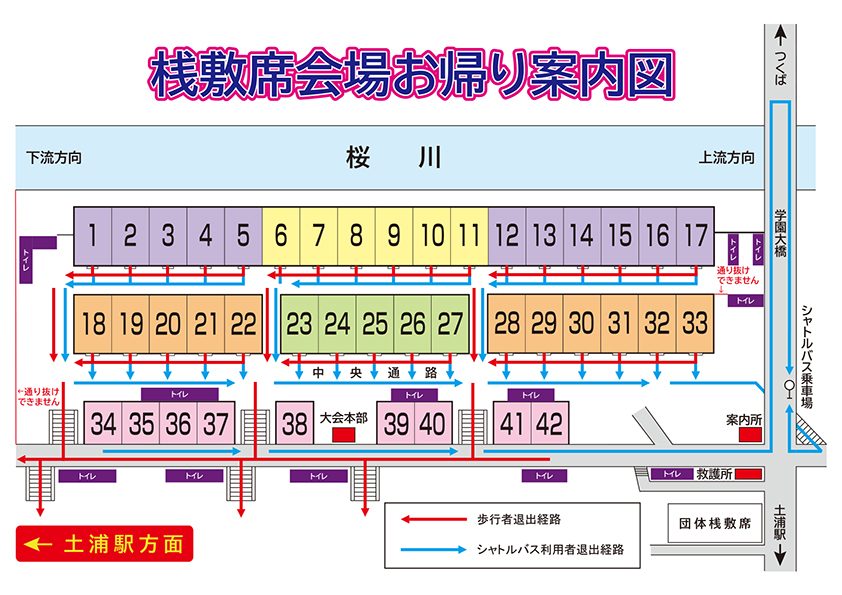
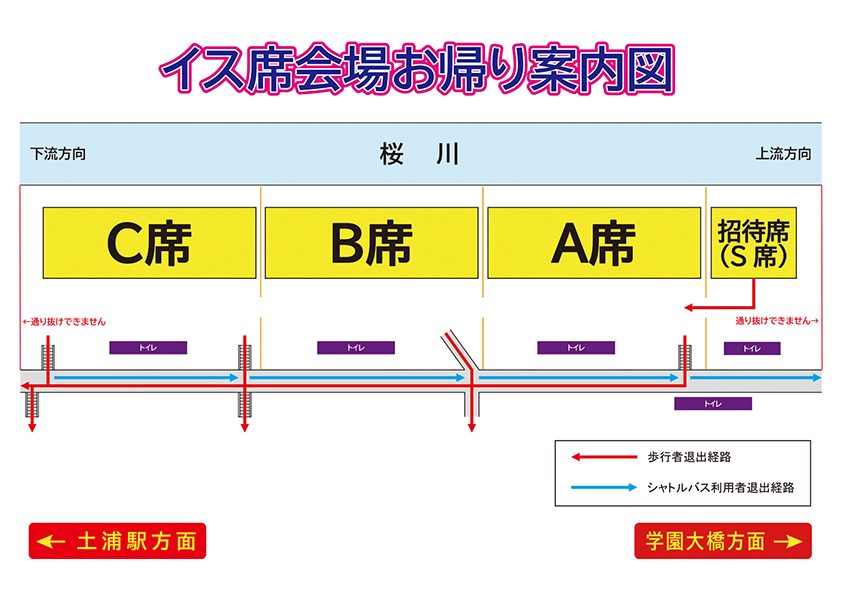
Put together with the seat comparison above, this is the whole decision: pick your zone on the overview, then find your exact plot or block on the detailed maps.
Tickets: the 2026 situation & your realistic options
The main viewing areas at Tsuchiura are all paid, reserved seating, sold by the organisers as physical paper tickets (official site: tsuchiura-hanabi.jp). Sales normally open with a lottery application round in summer, followed by general sales — and the sajiki plots and table seats, the seats everyone wants, sell out first.
Missed out? Your options
- Watch the official site for any late announcements — returned tickets are rare, but the organisers' notices are the only primary source worth trusting.
- Be very careful with resale listings. Tsuchiura tickets fall under Japan's anti-scalping rules for designated events. The organisers have issued a public warning about high-price resale of seats for the 95th edition, and tickets obtained in violation of the rules can be refused at the gate.
- Use a trusted proxy-buying service. MoooFee Travel sources Tsuchiura tickets for overseas visitors, and can post your paper tickets to your hotel in Japan or arrange pickup in Tokyo (Ikebukuro) before the day — ask on Ko-fi.
Ticket rules to plan around
- Entry is by paper ticket only. Before you travel to the venue, give every member of your group their own ticket — mobile coverage around the river is heavily congested on the night, and "my friend has the tickets" fails exactly when you need it.
- Festival tickets are generally non-refundable for personal reasons, and seat changes are not possible after purchase — double-check your date, headcount and seat type before you buy.
- If severe weather postpones the event to November 14, tickets normally remain valid for the new date. Follow the organisers' announcements on the day.
Planning a whole trip around the festival?
The Full Trip Ticket Concierge builds your complete Japan & China ticket and transport plan in writing — festival seats, attraction tickets, trains and backups — delivered within 72 hours of your request form.
See the concierge on Ko-fiGetting there from Tokyo — and getting home
Getting there
- Train: JR Joban Line from Ueno in Tokyo to Tsuchiura Station — roughly 60 to 80 minutes depending on the service. Limited express Hitachi and Tokiwa trains are fastest; rapid services are fine for most visitors.
- Shuttle bus: on the day, shuttle buses usually link Tsuchiura Station's east exit with the venue area near Gakuen Ohashi Bridge. The drop-off still leaves a walk to your seating zone, so follow the official traffic-control map and use the entrance shown for your seat type.
- By car: roads around the venue are closed to general traffic and parking is limited and pre-arranged. Go by train.
- Timing: aim to be settled in your seat by about 16:30. Food stalls open earlier, the riverside fills quickly, and finding your exact plot in the dark is nobody's idea of fun.
Getting home — read this twice
The show ends at 20:00, but the evening does not. Paid areas leave in stages under staff direction — the sajiki zone in particular exits in batches — and the queues for shuttle buses and for Tsuchiura Station are long and slow. Allow a full extra hour before you expect to board a train, and do not build your night around a tight last-train connection.
- Check the last trains toward Tokyo before you go, and treat them as a backstop, not a plan.
- If your group includes children or older travellers, consider staying the night in Tsuchiura or nearby Mito and travelling back fresh the next morning.
- Keep your ticket stub until you have fully left your seating area — zone staff may ask to see it.
What to bring & on-the-day tips
- Warm, windproof jacket and proper layers — a November riverside evening drops to around 10 °C or below, and you will be sitting still for over two hours
- Hat, gloves and disposable hand warmers (kairo) — cheap at any convenience store, priceless by 19:00
- A seat cushion — essential on sajiki board plots, kind on pipe chairs
- Rain poncho (clear is best) — umbrellas block views and are discouraged inside the seating areas
- Power bank and cable — cold batteries drain fast, and you will take a lot of photos
- Offline copies of your ticket details, hotel address and train times — the network around the venue jams at peak moments
- Cash and small coins for food stalls; some stalls are cash-only
- Backup food and drinks bought in advance — stall queues peak just before the start
- A small rubbish bag — the rule at Japanese festivals is simple: take your litter home
- Hand towel or wet wipes — stall food is glorious and messy in equal measure
Making the most of the night
- Eat early. The food stalls (yatai) around the venue are half the festival — graze from mid-afternoon rather than queueing at 17:15.
- The programme alternates competition entries with organiser showcases. The No. 10 shell division is worth your full attention: one shell, one perfect flower.
- Photography: keep tripods compact inside paid seating, and never stand in front of seated spectators during a sequence.
- Check the weather call before you leave your hotel — postponement decisions are announced by the organisers on the official site and social channels on the day.
- When the finale ends, stay seated until your zone is called. The staggered exit feels slow, but it is how 45,000 people leave a riverbank safely.
One last thing
Tsuchiura is the pyrotechnicians' championship: one night, about 20,000 shells, and a hundred years of pride behind every burst. Dress warm, arrive early, eat something from a stall, and let the competition do the rest.
If this guide helped, you can download the full PDF free on Ko-fi, leave a tip there to keep the guides coming, or find me for tickets and trip planning — I'm one message away on Ko-fi.
Visit MoooFee Travel on Ko-fiQuick FAQ
Are Tsuchiura 2026 tickets still on sale?
Official advance sales for the 95th edition have ended, and the headline seat types sold out. There are no ticket windows for the paid seating areas on the day — entry is by advance paper ticket only. If official announcements reopen anything, the organisers' site is the only primary source worth trusting.
What happens if it rains on November 7?
Light rain does not usually stop a Japanese fireworks competition. If severe weather makes firing impossible, the 95th edition is postponed to Saturday, November 14 — the decision is announced by the organisers on the day, on the official site and social channels. Tickets normally remain valid for the postponed date.
Which seats are best for a couple, or for a group?
For two people, the Sajiki Half Plot is the classic choice — your own boarded space on the riverbed facing the launch sites. A group of four fits the Sajiki Table Seat (a table and four chairs on its own plot); groups of up to five take a Sajiki Full Plot. Solo visitors are best served by the Sajiki Chair Seat or Chair Seats A–C.
Can I watch without a paid ticket?
The main riverbank areas facing the launch sites are paid, reserved seating — that is where the competition is judged from and where this guide's maps apply. Free viewing spots exist further from the venue, but they fill early, sit much further from the shells, and are not covered by the seating maps or the shuttle-bus plan.
How long does getting back to Tokyo take after the show?
Longer than the map suggests. The show ends at 20:00, but paid areas leave in stages and the queues for shuttle buses and Tsuchiura Station are slow. Allow a full extra hour before you expect to board a train, and do not build your night around the last train back to Tokyo.
I'm visiting from overseas — how do I actually get paper tickets?
Tsuchiura tickets are physical paper tickets sold through Japanese channels. MoooFee Travel sources them for overseas visitors and can post your tickets to your hotel in Japan or arrange pickup in Tokyo (Ikebukuro) before the day — ask on Ko-fi. Be careful with resale listings: the organisers have warned about high-price resale for this edition, and tickets obtained in violation of Japan's anti-scalping rules can be refused at the gate.
Facts checked against the Tsuchiura National Fireworks Competition executive committee (tsuchiura-hanabi.jp) and Tsuchiura City sources, October 2026. Event details can change; always confirm the latest official announcements before you travel. This is an independent guide and is not affiliated with the event organisers. Last updated: October 20, 2026.